
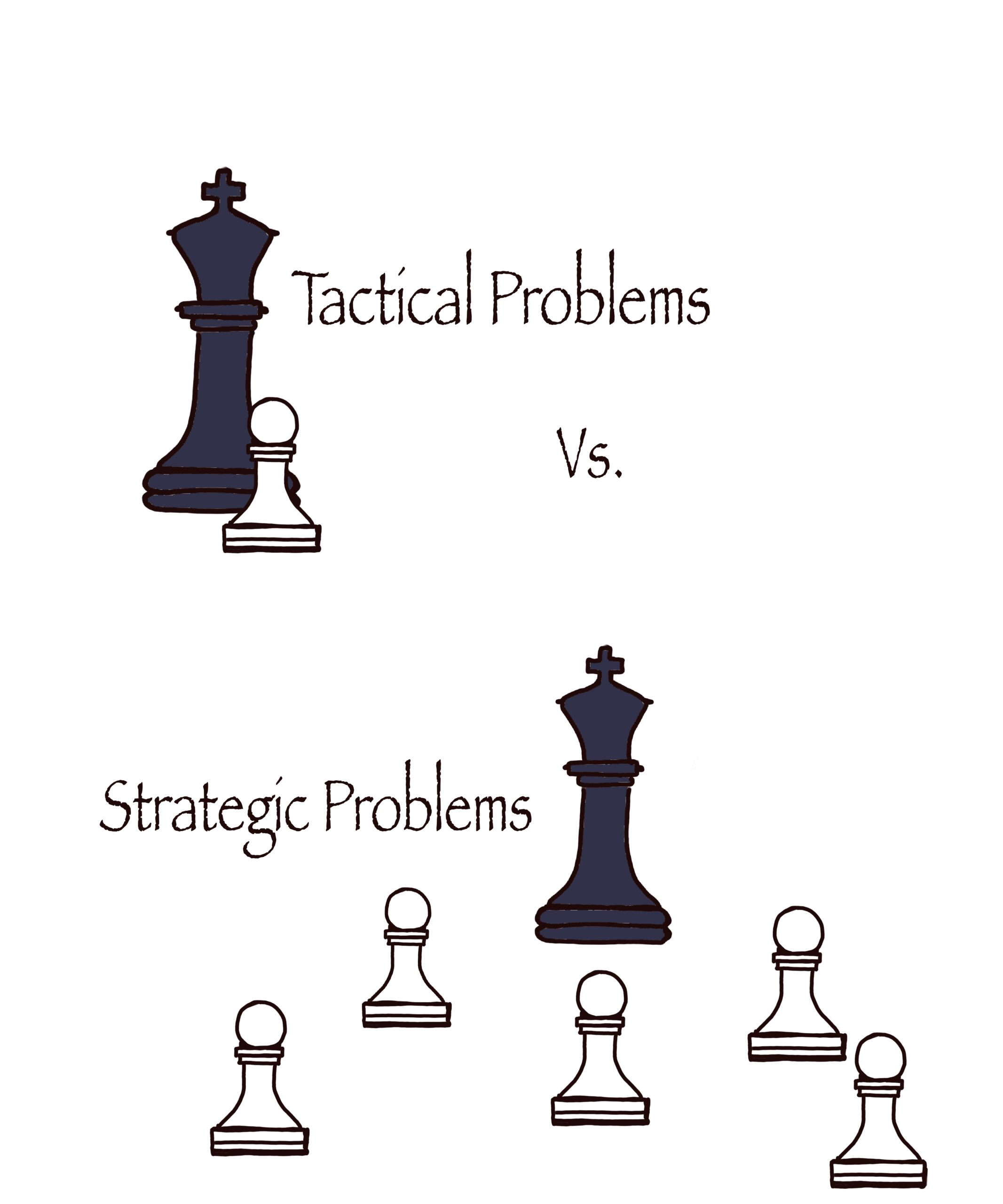
3. Tactical vs. Strategic Problem Solving (example I)
Shift your thinking
Problem identification is perhaps the most critical step of any Problem Solving Process. Get it wrong and regardless of your analysis and how well you execute your solution, you may still be confronted with the same issue after all the effort. To help identify the problem (and therefore the solution) shift your thinking from a tactical to a strategic frame of mind. (Tactical vs Strategic Problem solving)
In Alaska, many adventurous people love to trek in the untamed wilderness. As the ‘untamed wilds’ is just five minutes out of any town, such experiences are common. In season, bears are a major concern to hikers as any confrontation with one can be disastrous – there are many more bears in Alaska than there are people. As such, every prudent hiker should develop his plan of action before meeting a bear. Here’s an example of two fictitious hikers, one solving the problem thinking tactically, they other, thinking strategically.
Tactical Thinking
Our first hiker, recognizing that the bear is a massive predator with greater strength and speed than any hiker, decided he needed to defend himself from the bear by having the capability to stop it. He decided to arm himself, and in the event of a physical encounter he would shoot the bear. Being the smart problem solver, he looked at all the facts bearing on the situation, compared possible alternative weapons systems and selected the biggest, most expensive pistol he could carry. He reasoned that the .450 Magnum pistol, armed with steel penetrating bullets could put a bear down. Anything less, was risky. He then bought hundreds of bullets and spent hours and hours at the local range until he could effectively employ his weapon system.
So, in this story he and a hiker friend encountered a bear and when the bear charged, he employed his hours and hours of training, fired his very expensive and heavy pistol, with his very expensive bullets and hit the bear three times in the torso. Success, he accomplished just what he intended to do, shoot the bear and kill it! However, as a bear’s heartbeat is so slow, before bleeding out, he had time to reach the hiker, maul him, then hobble off to another corner of the woods to die. His friend, who didn’t carry a weapon, and did not go through an in-depth decision making process, hiked off to the Ranger station to report his friend’s passing.
Strategic Thinking
Another hiker, after having thought through this problem strategically, found himself in exactly the same predicament. He too carried a pistol into the woods with his hiking friend. The friend felt comforted knowing that one of them was armed. Contrary to the other hiker’s assessment, this hiker determined he only needed the lightest, cheapest, least powerful pistol he could find.
Upon the encounter with the bear, the hiker removed his pistol from holster. His friend, upon seeing the .22 snub nosed pistol, exclaimed that he was an idiot for bringing such a small and ineffective pistol to a bear encounter. At which point the armed hiker responded, ‘Friend, I don’t need to outrun the bear, nor kill the bear, I just need outrun you!’ He then shot his friend in the knee and took off running to the Ranger station to report the bear attack and the death of his friend. He too, succeeded at solving his problem.
Problem Identification – the Root to Strategic Problem Solving
Each hiker looked at the same problem, one tactically, the other strategically. And through those different lenses they each developed different problems to solve. The tactical thinker deduced that he needed to survive a bear encounter by killing the bear. The strategic thinker decided that he needed to survive the encounter. The same problem, two different problem statements two different solutions, two different outcomes.
Interesting Links
- To continue on to a second, perhaps less flippant, example of Tactical vs Strategic Problem solving , link here Example II
- If you enjoyed this article, link here to our others
- See a few of our articles posted in Linkedln
Want to offer comments, the form below is for YOU!




This is very interesting, You’re a very skilled blogger.
I have joined your feed and look forward to seeking more of your magnificent post.