
1. Strategic Planning, a simplified template
Strategic Planning
Strategic Planning need not be a complex and challenging undertaking; indeed, with this simplified template, anyone can better plan for their success.
I recently attended a planning session for a state chapter of a national organization. It quickly devolved into a ‘tail-chasing’ session with a few popular, but unfocused activities placed on the new annual calendar. It was evident that the meeting results would only further the strategic aims of the organization by happenstance, not as a result of a well thought out strategic planning process. We have all been to these types of meetings, and perhaps, we may have even been responsible for a few. A cause behind these dysfunctional efforts stems from a poor understanding of not only how to strategically plan, what makes up a strategic planning effort, but also what a strategic plan is designed to achieve.
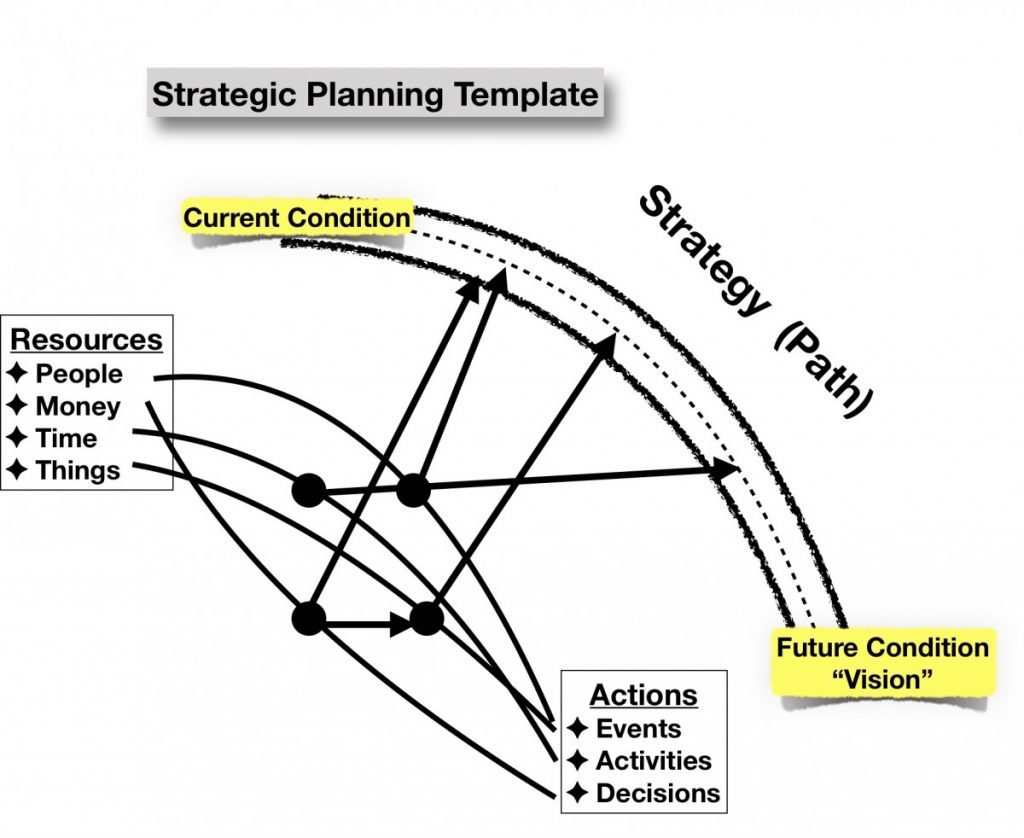
A simplified description of Strategic Planning is the process of conceiving a path (strategy) to achieve an outcome by linking Action with Resources.
A Strategic Planning Template drives the planners to estimate the current condition, clarify what tools are available, and then help the planner conceive a path for a series of actions implementing those tools to achieve that desired end-state or condition. This template relies on four constituent elements: Vision, Resources, Actions, and Inventiveness.
– Vision:
Vision is the condition or environment in which you (or your business) wish to exist. As one example, ‘To be the largest, quality producer of widgets in the local area.’ Or, perhaps, ‘To be a graduate of the best law school in the nation.’
Understanding your current condition is critical to laying the path to achieving that future condition. Situational Awareness is derived from knowing yourself, your obstacles, and your environment. A keen awareness of ‘yourself’ helps define the gap between your present condition and the future, desired condition. A Mission Statement articulates the focused effort to bridge that gap. The Strategic Plan is the set of instructions to guide the way.
For a more detailed discussion on situational awareness link here
– Resources:
Part of knowing yourself (situational awareness) is understanding what resources are available to bear on the effort. Essential resources include People, Time, Money, Material, and Things.
– Actions:
The catalyst for change from the current condition to the desired condition, is action. Actions are Events, Activities, and Decisions.
– Inventiveness:
Inventiveness is perhaps the most helpful element of strategic planning. It is part science, part art. Inventiveness helps to creatively and systematically develop effective courses of action (or strategies) to employ available resources, in sequence, and measure, along a contiguous and uninterrupted path towards the desired condition.
In theory, Strategic Planning is simple. It is the act of conceiving a path (strategy), using inventive and effective actions employing resources to change the current condition to a future, desired condition. It’s easy enough to develop events and activities employing people, money, and materials. However, a strategic plan filled with events and activities may only be a plan with lots of motion, but not one that achieves its purpose. Each element of a Strategic Plan (vision, resources, action, inventiveness) has a relationship with each other. Their implementation should be nested and supportive towards achieving continuity along the planned path.
Misaligned activities commit limited resources and preclude their productive employment towards this transition. With a clear understanding of the elements of strategic planning and the relationship between them, we can better understand how to effectively develop a strategic plan to achieve some future desired outcome or condition. With this clearer understanding, we may also avoid the frustration that comes from ‘tail-chasing’ planning sessions.
Interesting Links
- If you found this article informative, link here to our others
- See a few of our articles posted in Linkedln
Want to offer comments, the form below is for YOU!





There is a luminous patience in your writing, allowing understanding to unfold slowly and naturally. The sentences cultivate awareness, encouraging the reader to dwell on meaning, perceive subtle nuances, and experience insight as a gentle, enduring resonance rather than a sudden revelation.
A simplified template is a great idea – strategic planning can easily become overwhelming.