USAREUR Focused Logistics
In 1997 I was a major in the Current Operations Branch of the USAREUR logistics directorate in Heidelberg, watching a theater support structure get rebuilt in real time. The Balkans deployment was underway, the Army had just published Vision 2010, and the question in front of us was whether the doctrine described on paper matched what logisticians were actually doing in the field. It did — closer than most of us expected.
This article was my attempt to document that. It ran in Army Logistician in the November–December 1997 issue, and reading it now, what stands out is not how much has changed but how familiar the problem set remains. Radio frequency tags, total asset visibility, in-transit tracking, the ability to redirect materiel while it is still moving — these were the emerging capabilities of 1997. The technology has advanced beyond recognition. The underlying objective has not: get the right support to the right unit without moving more than you need to.
There is a second reason I am reprinting it here. Every capability described below improved a single function. Tracking got better. Inventory got better. Distribution got better. Each was real, and each was measured within its own lane. That is precisely the pattern I have argued elsewhere marks the difference between improving a system and transforming one. Reading a 1997 snapshot of domain-by-domain progress is a useful way to see what that distinction looks like in practice.
The article follows as originally published.
USAREUR Focused Logistics
by Major Darren B. Zimmer
U.S. Army, Europe, logistics operations directly parallel the Army Vision 2010 concept of focused logistics.
In preparation for the Army’s leap into the 21st century, logisticians of U.S. Army, Europe (USAREUR), have transformed the European theater support structure to conform to the Army’s Vision 2010 model. This can be seen in USAREUR logistics operations for Operations Joint Endeavor and Joint Guard, which directly parallel the tenets of focused logistics stated in Army Vision 2010: fusion of information, logistics, and transportation technologies to provide rapid crisis response, to track and shift assets even while en route, and to deliver tailored logistics packages and sustainment directly at the strategic, operational, and tactical levels of operations.
Fusion of Information Technology
USAREUR’s modern information technology has enabled managers to make accurate and expedient decisions for the logistics support of Operation Joint Guard and its predecessor, Operation Joint Endeavor. Total asset visibility of materiel in the distribution pipeline makes it possible for USAREUR to divert backlogged cargo to alternative modes of transportation as well as obtain critical items through expedited deliveries. USAREUR routinely uses the Defense Transportation Tracking System to locate convoys. This system also has a remote equipment monitoring and diagnostic capability.
By using radio frequency (RF) tags, combat service support (CSS) activities can locate specific containers of supplies, rapidly inventory them, tailor them as necessary, and quickly transport the resulting push packages to the supported unit. The Standard Army Retail Supply System, incorporated throughout the theater and within the area of operations, is used to leverage theater stocks, streamline requisitions, support split operations, and manage materiel distribution. USAREUR logisticians also have introduced numerous logistics wargaming simulations into the planning process so they can develop alternative plans before operations occur.
On the strategic and operational levels, the global transportation network, joint total asset visibility, and World Wide Web systems, together with RF tags and Defense Transportation Tracking System transponders, help USAREUR and Department of the Army logistics offices monitor the flow of materiel and supplies from the United States directly to field units. This gives the decisionmakers information needed to streamline and enhance the logistics system where required. The Joint Operation Planning and Execution System integrates strategic and theater airlift, the theater rail system, and line haul. The Standard Theater Army Command and Control System is used to track real-time departures, in-transit locations, and arrival times of trains loaded with troops, equipment, and supplies. With this technology, the command logisticians can maneuver and redirect trains, buses, barges, and trucks that are en route, thus smoothing the flow through known choke points. Using these systems, the USAREUR logistics network is able to respond to the theater’s challenges at speeds that were not possible with the rigid organizational capabilities of the past.
Tailored CSS Organizations
The USAREUR CSS organization has been tailored to use the vast capabilities of the forces in Central Europe to support the unique nature of Operations Joint Endeavor and Joint Guard. Logistics efforts are coordinated through a focal point at the intermediate staging base (ISB) at Kaposvar, Hungary. From their forward position in the ISB, logisticians can manage the system skillfully and match support to requirements. They also can coordinate the day-to-day services and support provided to the field soldiers by various national support agencies, such as the Defense Logistics Agency (DLA) and the Army Materiel Command.
Within the Task Force Eagle area of responsibility, the support architecture is tailored similarly. Division direct support units are collocated with corps and echelons-above-corps support units as well as with the national support agencies’ field units. The synergy of this tailored support eliminates a lot of duplication and solves many of the problems associated with lack of communications and the inflexible nature of the traditional support architecture.
Throughout the theater, USAREUR works closely with the other services and Defense agencies to make the best use of the services available from businesses in the civilian sector. For example, DLA negotiated with European companies to obtain bulk fuel and subsistence locally. Also, USAREUR worked closely with DLA and the Hungarian and Croatian Governments to establish a system for reuse or disposal of scrap and uneconomically reparable equipment and materiel. Probably the most efficient use of civilian resources in the theater is the hiring of local civilians through the Logistics Civil Augmentation Program (LOGCAP) to provide services that the Department of Defense cannot perform.
USAREUR has embraced fully the Army Vision 2010 concept of focused logistics. Continued development and refinement of this concept by USAREUR and the rest of the Army will provide tremendous value to future generations of joint logisticians and their supported units.
Major Darren B. Zimmer is the support operations officer for the 201st Forward Support Battalion, 1st Infantry Division (Mechanized), Vilseck, Germany. When he wrote this article, he was the operations officer in the Current Operations Branch, Office of the Deputy Chief of Staff for Logistics, U.S. Army, Europe, in Heidelberg, Germany. He is a graduate of Washington State University, the Transportation Officer Basic and Advanced Courses, and the Combined Arms and Services Staff School.
Originally published as
Zimmer, Darren B., Major, USA. “USAREUR Focused Logistics.” Army Logistician: Professional Bulletin of United States Army Logistics, PB 700-97-6, November–December 1997, pages 24–25.
Reprinted with credit to Army Logistician and the author, in accordance with the publication’s stated reprint policy. Army Logistician is published by the Army Combined Arms Support Command, Fort Lee, Virginia. Articles express the opinions of authors, not the Department of Defense or any of its agencies.
Read the Original Publication (PDF) →Includes the issue cover, contents page, and both article pages as published.
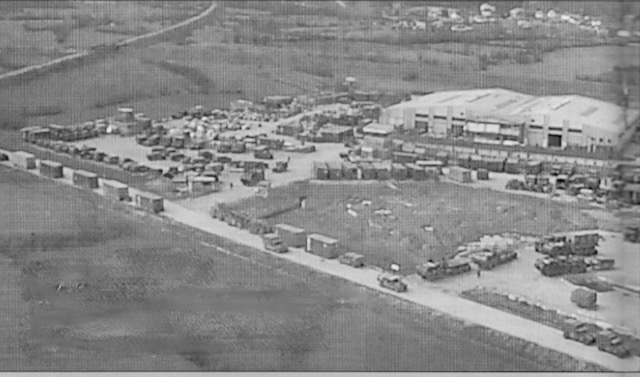
Header photograph: aerial view of Guardian Base, Bosnia–Herzegovina, as published in Army Logistician, November–December 1997. U.S. Army photo.
Looking Back
The technology has advanced considerably since 1997. Whether it has advanced to the point of sufficiency is a separate question, and one worth asking honestly.
Every capability described above made one function work better. Tracking improved. Inventory improved. Distribution improved. That was the achievement of the period, and it was also its limit. A theater that can locate every container, and separately optimize every convoy, and separately manage every stock position, is still making those decisions in isolation from one another. Better tools applied to the same fragmented structure produce a faster version of the same result.
Every function in your organization is probably performing better than it was last year. Is the organization? And if that answer is harder to give, where did the gain go?