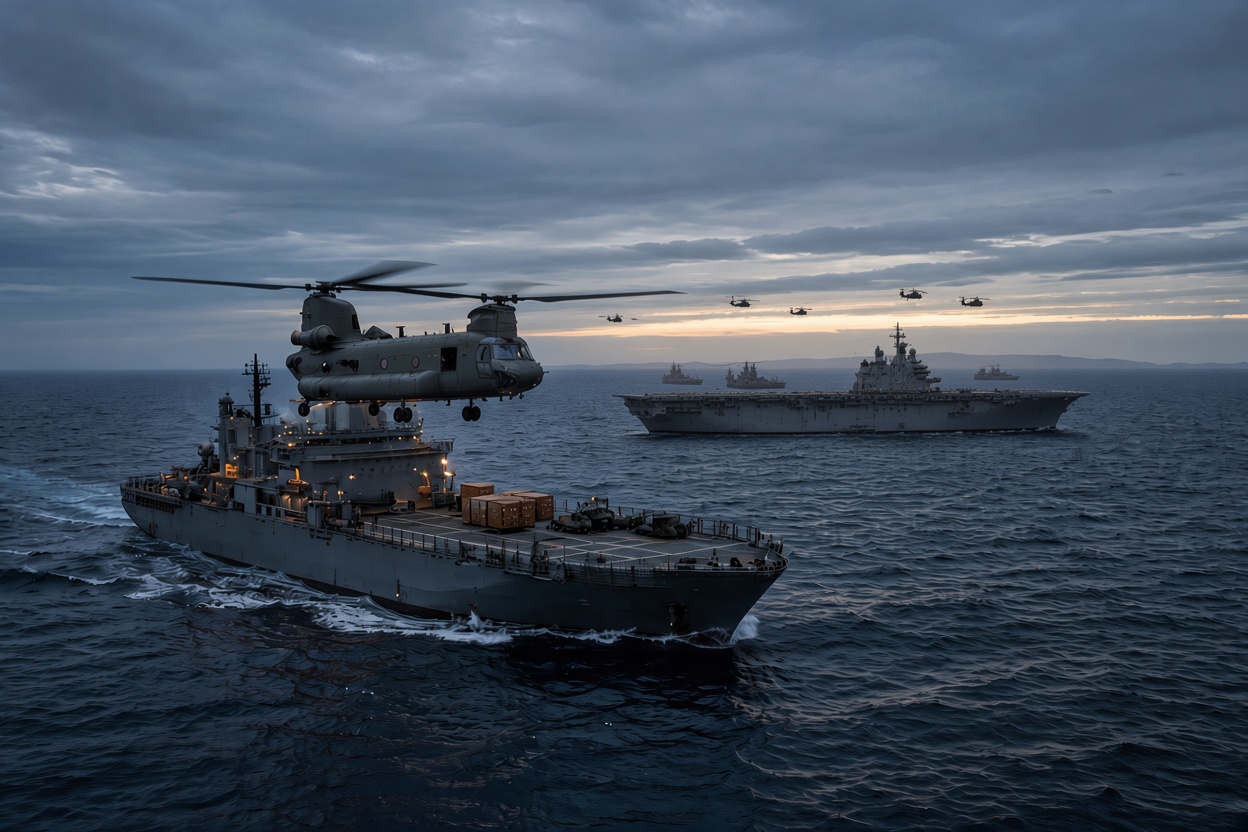
Contemporary Army Solutions to the JFC’s Seabasing Challenge
When I wrote this paper at the Naval War College in 2006, its premise required a deliberate act of imagination: that a Joint Force Commander might be denied the land bases his campaign depended on. That premise no longer requires imagination.
The paper’s finding was that the Army’s seabasing concepts could not meet the standard the joint community had set for them. The reason was not conceptual. It was arithmetic — lift ceilings, sortie counts, and fuel volumes that did not close, with every proposed solution eventually returning the force to a fixed position ashore. The recommendations that followed required no new program of record.
Originally submitted to the Naval War College’s Joint Military Operations Department, the paper is preserved here as part of my professional writing and military logistics archive.
Contemporary Army Solutions to the JFC’s Seabasing Challenge
Darren Zimmer, COL, USA
Naval War College — Joint Military Operations Department
Newport, Rhode Island — October 2006
21 pages · DTIC Accession ADA463677
Distribution Statement A: Approved for public release; distribution is unlimited.
Read the Original Paper (PDF) →Archival source: Defense Technical Information Center, ADA463677
Looking Back — Twenty Years On
The paper assumed access to land bases might one day be denied. Since then, basing and overflight access have been withdrawn by long-standing partners over policy disagreement rather than military necessity, and a critical maritime chokepoint has been closed for an extended period. The particular relationships will change again. What does not change is that access arrangements which appear settled are contingent on political circumstances that move faster than force structure can follow.
The Pacific presents the same problem in a different form. Even where partners remain willing to provide access, the distances involved may place those bases too far from the objective to be of operational use. Willingness and utility are not the same thing. A force able to project and sustain itself from the sea is exposed to neither limitation.
What the paper found, underneath the numbers, was a competition the Army had not resolved. The same aircraft required to employ the force were required to sustain it, and committing them to one left the other unresourced. Lift, fuel, maintenance, and security drew on the same finite assets, and optimizing any one of them degraded the others. That is the problem I have argued elsewhere artificial intelligence is suited to address — not by accelerating decisions inside a single domain, but by integrating them against a common reference. The tools to model those tradeoffs did not exist when this was written.
Some would say a twenty-year-old assessment of force structure has little to offer a force built around different units and different platforms. The formations have changed. The tradeoff has not, and neither has the arithmetic that produced it.
The conditions this paper anticipated have arrived, and the question it examined is more pressing now than when it was written. What does your planning assume about access — and what happens to that plan when the assumption fails?